What is the cockle?
Just below the surface of the sediment in the Pāuatahanui Inlet lives the New Zealand cockle. It is the most abundant shore animal in the Inlet.
Known to Māori as tuangi and to science as Austrovenus stutchburyi, the NZ cockle is a shallow-burrowing suspension feeder found in soft mud to fine sand on sheltered beaches around the coasts of New Zealand. It was scientifically described by the English surgeon and naturalist William Wood in 1828. He named it after the geologist Samuel Stutchbury, who collected cockles and other sea shells while he was the naturalist to the Pacific Islands from 1825 to 1827. The cockle is a dominant member of the fauna of estuaries and harbours right around New Zealand. Our last triennial survey, in 2019, estimated the Pāuatahanui Inlet population to be between 350 and 400 million individuals. It is estimated that around 80% of the total intertidal biomass of the Inlet is due to the cockles.
The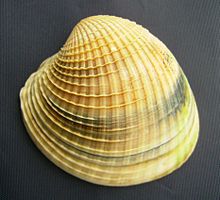 adult cockle has a rounded heart-shaped bivalved shell (when viewed side-on) with strong radial ribs and concentric grooves. The cockle’s shape and external structure anchor the animal in the sediment so it can’t be scoured out by waves and currents. The cockle’s large mobile foot allows it to burrow under the surface, although its rounded shape and short siphons mean it burrows only deep enough to cover the shell.
 How do cockles feed?
 How do cockles feed?
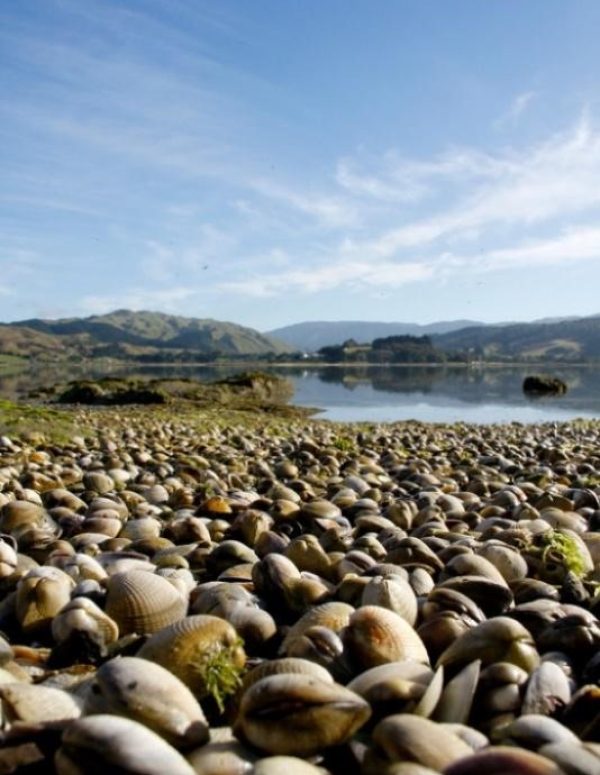
Cockles live throughout the subtidal and intertidal areas of the Inlet but are most abundant between the shallow subtidal (permanently covered by about 1 metre of water) and the middle of the intertidal areas. They are filter feeders, drawing water through their gills to get the food and oxygen they need. Those in the intertidal area must be submerged and, therefore, able to feed for at least three hours per day (1½ hours per tidal cycle).
The filter-feeding habit of cockles makes them essential to the water quality of the Inlet since they remove plankton and minute particles of organic debris and help to keep the water clear. It has been calculated that up to one-third of the volume of each incoming tides passes. population-wide, through their gills.
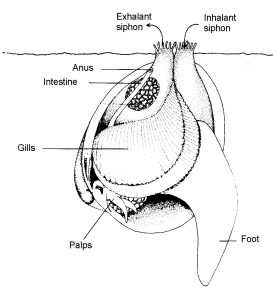
The cockle is known as a suspension filter feeder. When the tide covers the sand and the cockle is submerged, it opens its shell to expose two siphons, ‘inhalent’ and ‘exhalent’. When cockles are feeding, their siphons can be seen above the surface of the sediment. The foot is used to position the animal at the right depth below the surface of the sand.
Water is drawn water into its outer body cavity through its ‘inhalant’ siphon, straining the water through its gills to remove potential food particles suspended in the water. It then pumps the water out through its ‘exhalant’ siphon. The captured particles are moved down to the base of the gills and on towards the mouth by cilia (fine motile hairs). Large particles are removed by the ‘palps’ and redirected to the exhalant water stream. Small particles are directed into the mouth.