Pāuatahanui Wildlife Reserve
Pāuatahanui Wildlife Reserve is a 50-hectare wetland bird sanctuary that lies at the head of the Inlet, at its eastern perimeter, where the Pāuatahanui Stream completes its journey from the Haywards hills. It is environmentally significant as the largest remaining area of saltmarsh in the lower North Island. Originally developed as a sanctuary for birds in the 1980s, it has been developed to include a large area of coastal shrubs and trees that has become a sanctuary for many birds including the re-introduced fernbird that had once inhabited the area.
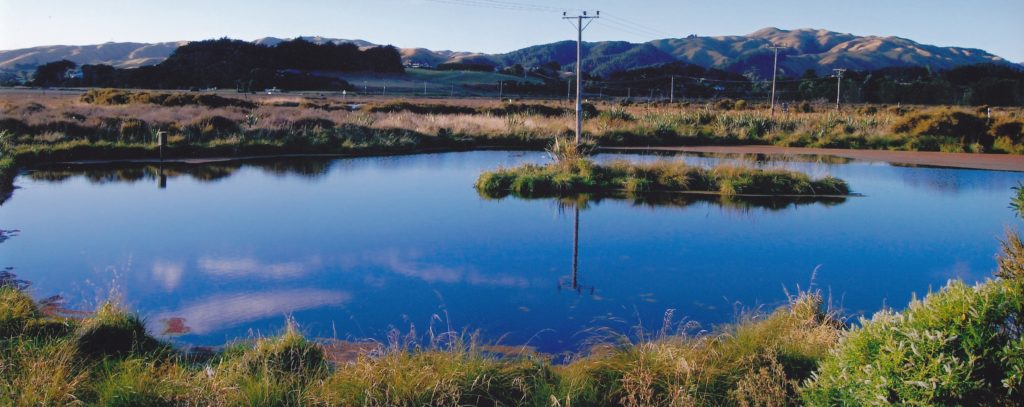
Of the 50 hectares, four hectares are owned by the New Zealand Forest and Bird Protection Society (Forest&Bird) and protected under a covenant with the Queen Elizabeth II Trust. The rest of the reserve is owned by the Department of Conservation (DOC).
More information can be found on the F&B page for the Wildlife Reserve.
Development of the Reserve
As early as 1979 the land that is now the Wildlife Reserve was identified as the ideal location for a wading bird reserve. It had for some time been a Public Domain where a stock-sale yard, BMX track and tennis court were located. The area was eventually designated a Wildlife Reserve in 1985 and was opened to the public on 15 April 1989.
The primary aims of the original Reserve management team were:
-
-
- to protect and enhance habitat for waterfowl;
- to protect the saltmarsh and create a more diverse habitat by developing flax swamp, manuka/kanuka forest and coastal shrubland around the saltmarsh;
- to provide visitor access to significant parts of the Reserve so that it could be used without disturbing wildlife.
- to protect and enhance habitat for waterfowl;
-
Since 1985, the Reserve has seen a number of developments to support these aims. Shallow ponds known as ‘scrapes’ were developed for wading birds, with islands created for nesting sites, tracks and boardwalks were built around the saltmarsh, and hides were established so that visitors could observe the birdlife. A plant nursery was established from which thousands of trees and shrubs, flaxes and sedges were grown from seed and transplanted out around the various habitats within the boundary.
Starting from an initial land area between Grays Road to the north and Pāuatahanui Stream to the south, additional blocks of land were purchased by DOC so that the full Reserve extends north of Grays Road alongside Ration Creek, and the southern banks of the Pāuatahanui Stream out to SH58.
Over the years, volunteers have worked tirelessly to restore the fragile wetlands, which now allow people to visit and enjoy the Reserve in tranquil harmony with its natural fauna. It is also a great educational site with several wheelchair friendly pathways and boardwalks leading to strategically placed viewing hides that allow visitors an ability to study the wading birds without disturbance.